Introduction
If your identity verification flow already complies with the GDPR, most of it will fit the LGPD, Brazil's data protection law. The two laws share the same structure: legal bases, data subject rights, special protection for biometric data and a supervisory authority. What changes for identity verification are the details: the list of legal bases, an explicit fraud prevention basis for sensitive data, a short breach notice deadline, and a different fine model.
This article compares the two laws from the point of view of a KYC or onboarding team. It is a practical overview, not legal advice: confirm your obligations with counsel in each jurisdiction.
The two laws at a glance
The GDPR (Regulation (EU) 2016/679) applies in the European Union since May 2018. The LGPD (Brazil's General Data Protection Law, Law 13,709/2018) was inspired by it and is enforced by the ANPD (Brazil's national data protection authority).
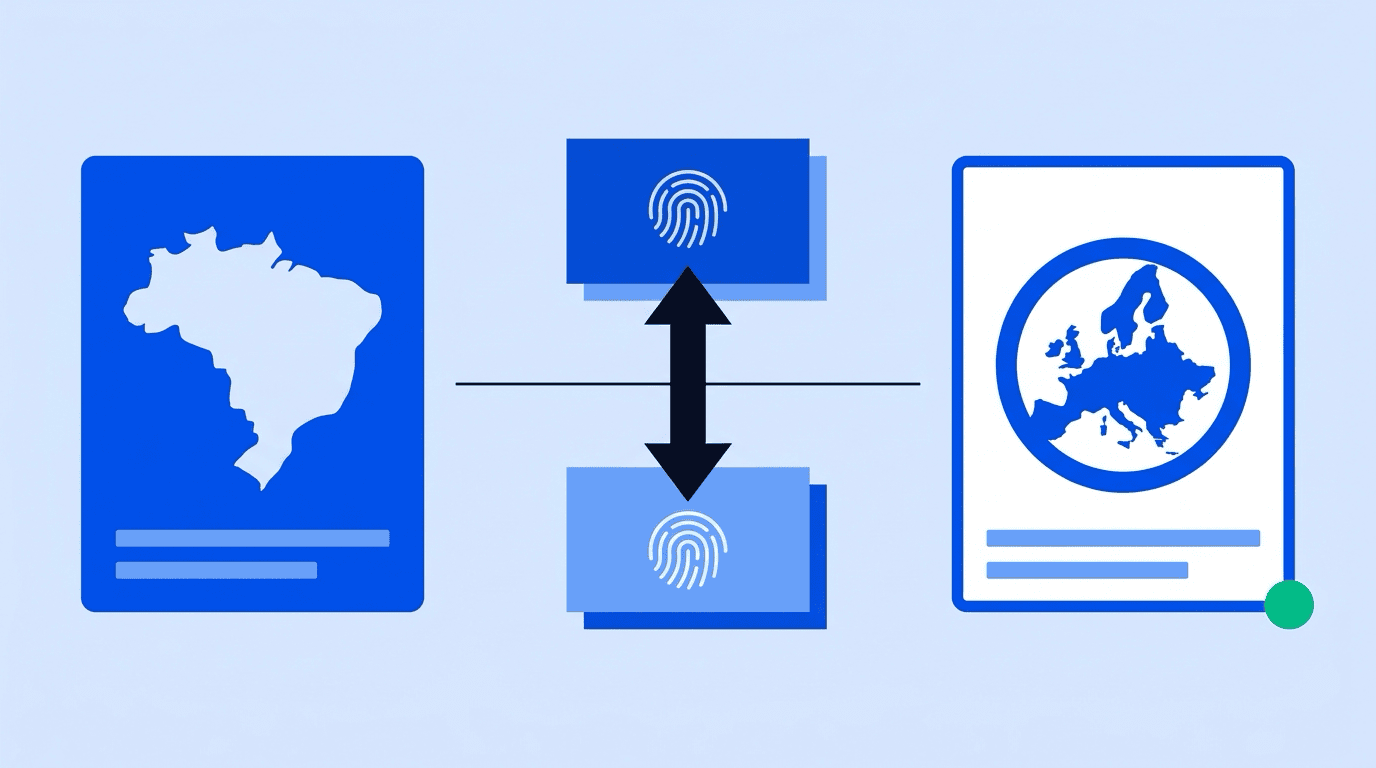
Both reach companies outside their territory. The LGPD applies when processing happens in Brazil, when it aims to offer goods or services to people in Brazil, or when the data was collected in Brazil (Article 3). A European or US company onboarding Brazilian users is covered by both laws at once.
Side by side for identity verification
| Topic | GDPR | LGPD |
|---|---|---|
| Legal bases | Six (Article 6) | Ten (Article 7), including credit protection |
| Biometric data | Special category when used to uniquely identify a person (Article 9) | Sensitive data (Article 5) |
| Basis for biometrics in fraud prevention | Must fit one of the Article 9 exceptions | Explicit basis: fraud prevention and security of the data subject in identification and authentication (Article 11) |
| Automated decisions | Right not to be subject to solely automated decisions with significant effects, with exceptions (Article 22) | Right to request review of automated decisions (Article 20) |
| Data protection officer | Required in specific cases (Article 37) | The controller appoints an encarregado (Article 41), with exemptions set by the ANPD |
| Breach notice to the authority | Within 72 hours where feasible (Article 33) | Within three business days under ANPD rules |
| Fines | Up to 20 million euros or 4% of worldwide annual turnover (Article 83) | Up to 2% of revenue in Brazil, capped at 50 million reais per infraction (Article 52) |
| International transfers | Adequacy, standard contractual clauses and other tools (Chapter V) | Similar tools (Article 33), with standard clauses approved by the ANPD |
What actually changes for a KYC flow
Legal basis for CPF checks
Checking a CPF (Brazil's individual taxpayer ID) against registry data is ordinary personal data processing. The usual bases are compliance with a legal or regulatory obligation, for regulated sectors, and legitimate interest in preventing fraud, for everyone else. That mirrors what you would document under the GDPR. Note your basis per purpose in your records.
Biometrics: a clearer path in Brazil
This is the most useful difference for KYC teams. Under the GDPR, a selfie compared with an ID photo processes special category data, and you need one of the Article 9 exceptions, often explicit consent or a legal basis in member state law. The LGPD lists, among the bases for sensitive data, the guarantee of fraud prevention and of the data subject's security in identification and authentication processes in electronic systems (Article 11, II, g). It still requires that the data subject's fundamental rights do not prevail, so transparency and proportionality matter.
Automated rejection
If your flow rejects users automatically after a failed match, both laws give the user a way to challenge the decision. Under the LGPD the user may request a review of decisions taken solely by automated processing. Keep a manual review path and log the reasons for each decision.
Breach notice
The GDPR's 72-hour window is familiar. Under the ANPD's incident regulation, the controller must notify the authority and affected data subjects within three business days of learning that a security incident affected personal data, when it may cause relevant risk or damage. The ANPD's incident reporting page explains the process. Your incident runbook needs both clocks.
Retention
Neither law sets a fixed retention period for KYC data. Sector rules do. In Brazil, financial institutions keep identification records under anti-money laundering rules, while a marketplace with no such duty should keep only what it needs and delete the rest. Document images and selfies are the first candidates for short retention.
A practical checklist for teams with a GDPR program
- Add Brazil to your records of processing, with the LGPD basis for each purpose.
- Appoint an encarregado (the LGPD's data protection officer role) and publish the contact, unless an ANPD exemption applies to you.
- Update the privacy notice in Portuguese for Brazilian users, stating what you check and why.
- Map international transfers of Brazilian data and use the mechanisms of LGPD Article 33.
- Adjust the incident runbook to the three business day deadline.
- Keep a review path for automated rejections.
Where CPFHub.io fits
CPFHub.io provides the identity data used in Brazilian KYC: the Simple Lookup for name, gender and date of birth, the Real-Time Lookup for registration status at the Receita Federal, and Identity Verification for document, liveness and face match. A minimal call from your backend:
curl --max-time 10 \
  -H "x-api-key: YOUR_API_KEY" \
  -H "Accept: application/json" \
  https://api.cpfhub.io/cpf/00000000000
How CPFHub.io handles data is described on the security and compliance page.
Frequently asked questions
Is the LGPD the same as the GDPR?
No. The LGPD was inspired by the GDPR and shares its structure, but the legal bases, breach deadline, data officer rules and fines differ. A GDPR program is a strong starting point, not automatic compliance.
Does the LGPD apply to a European company?
Yes, when the company processes personal data of people in Brazil, offers them goods or services, or collected the data in Brazil. Article 3 of the LGPD sets this territorial scope.
Can I use selfies for fraud prevention under the LGPD?
The LGPD has a specific basis for sensitive data used to prevent fraud in identification and authentication processes. You still need transparency, proportionality and a review of the data subject's rights. Confirm your setup with Brazilian counsel.
How fast must I report a data breach in Brazil?
Under the ANPD's incident regulation, within three business days of learning that an incident affected personal data, when it may cause relevant risk or damage. Notify the affected data subjects within the same period.
Read also
- LGPD for Foreign Companies Processing Brazilian Personal Data
- Brazil KYC Requirements in 2026: What Foreign Companies Need to Know
- Document and Selfie Verification for Brazilian Users
- Brazil's CPF vs European National ID Numbers (DNI, NIF, Codice Fiscale)
Conclusion
For identity verification, the LGPD and the GDPR agree on the essentials: a documented legal basis, extra care with biometrics, user rights over automated decisions and prompt breach notice. Brazil adds an explicit fraud prevention basis for sensitive data, a three business day breach deadline and fines tied to revenue in Brazil. Adjust those points and your GDPR program will carry most of the weight.
Test Brazilian identity checks with 50 free credits and no credit card at cpfhub.io.
CPFHub.io
Ready to integrate the API?
50 free credits to test now. No credit card. Instant access to the documentation.